The Stone Badge, Hidden Like a Ghost
Past 10% of Stone Island's total revenue — why hiding the badge commands the highest prices.
Stone Island's yellow-and-green compass badge is far more than a logo. From British football casuals to the American hip-hop scene, it has been a subculture medal for some, a proof of hype for others. But as the compass badge grew commonplace on the street, top-tier consumers began looking for another way to set themselves apart. The fact that the brand's most expensive, hardest-to-find line is — paradoxically — the one that 'erased the badge' cuts straight through the current of today's fashion market.

Filtering by Deleting the Compass
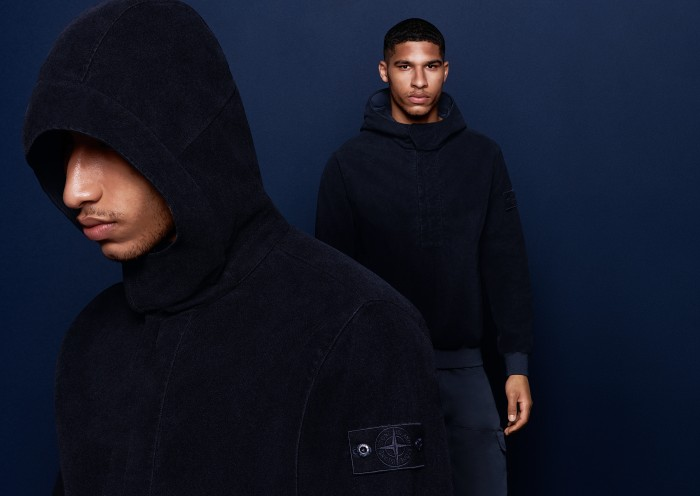
First introduced in 2011, the 'Ghost Piece' began by completely inverting the concept of camouflage. Rather than blending into its surroundings, it chose 'to dissolve into itself.'
The garment's fabric, zippers, buttons — and even the iconic compass badge — are unified in a single color. By dyeing the badge, the very thing considered the brand's everything, the same color as the garment to conceal its presence, the line began functioning as a perfect 'filter' for high-end consumers fatigued by loud logo play.

An Anchor Product for Retailers
Look at the brand's recent report card and you'll find the Ghost line has grown to account for 10% of total revenue. That number sends retail buyers a highly strategic message.
The Ghost line runs on a different track from the mainline. Split-leather pieces can exceed $7,000. It means the consumers who once chased streetwear hype have matured into a luxury target with real purchasing power. Rather than forcing price increases across its entire range, the brand successfully landed a high-price line and lifted its whole positioning into luxury territory. From the "there, but invisible" ghost-badge strategy, stores looking to prove their curation through quality can draw a real hint.

A Barrier to Entry No One Can Imitate
The core of the Ghost line's persuasiveness in the high-end market lies in the technical moat of garment dyeing. The ghost badge isn't attached separately — it goes through the dye process together with the jacket body.
Making a wool badge and a leather or nylon body converge on exactly the same shade when they enter the same dye bath is an extremely difficult engineering challenge. Even Stone Island itself concedes that achieving the monotone is far more complex engineering than simple color-matching. It's why Ghost, which started with waterproof Ventile fabric in 2011, took a full fifteen seasons to expand into leather and suede. This inimitable technical detail is precisely the logic that justifies the premium tag.

Wearing the Texture of 'Tree Bark'
The keyword of the SS26 season is 'Corteccia.' Italian for tree bark, the color draws inspiration from the deep brown of work leather gloves.
The campaign casting is just as deliberate. From architect Philippe Starck to actor Cha Seung-won and football legend Paolo Maldini, the brand foregrounds 'mature figures who have mastered their own fields' rather than any particular generation or subculture. It's proof that Ghost has evolved beyond trend-dependent streetwear into a category spanning the whole of high-end lifestyle.
Side Notes
The badge's secret: The ghost badge is detachable, but because it's dyed together with the garment, it's treated as effectively 'one body' — the reason ghost badges rarely circulate on their own in the vintage market.
Osti's legacy: Founder Massimo Osti said clothes are too expensive to answer only to aesthetic requirements. Ghost is the line that proved that expensive price through the unshowy 'depth of color' and 'scarcity of material.'